

Electric car depreciation: how does it affect resale value?
The resale value of an electric car is the estimated amount a used EV can be sold for, and it's largely determined by electric car depreciation, or how much value the vehicle loses over time.
Just like petrol and diesel cars, EVs begin losing value the moment they leave the showroom and are classified as second-hand vehicles from that point on.
Electric car depreciation refers to how much value an EV loses over time. Many of the key factors that affect all cars' value, such as age, mileage, and condition will influence an electric car valuation.
However, battery health, evolving market demand, and policy incentives also play a bigger role for EVs than they do for petrol or diesel cars.
Get a free valuation
Key takeaways
- According to a Cox Automotive depreciation report, EVs currently depreciate slightly faster than petrol equivalents, around 38-42% after three years versus 35-40%, but the gap is closing.
- Electric Car Scheme noted that in 2025, used EV prices fell 7-9% from the previous year and sales grew significantly, with record transactions and a rising market share.
- Residual values vary widely across EV models, with the Hyundai Ioniq range among the better performers in the UK market, according to Oracle Car Finance data. Hyundai's 8-year/100,000-mile battery warranty, with a minimum 70% capacity guarantee, helps support used values while coverage remains active.
- EVs that have aged out of warranty tend to depreciate more sharply as buyers factor in the risk of battery replacement.
- Battery health is fast becoming as important to buyers as mileage or service history, and transparency around condition supports stronger resale prices.
- With the 2030 petrol/diesel ban approaching and the UK's Zero Emission Vehicle (ZEV) mandate already requiring 33% of new car sales to be electric in 2026, rising to 80% by 2030, demand for used EVs is only expected to grow based on current trends.
What is EV depreciation?
Car depreciation refers to the reduction in a vehicle's market value over time. EV depreciation specifically refers to the market value reduction of electric vehicles.
Depreciation is considered one of the biggest cost factors when it comes to buying or running a car.
By understanding how depreciation comes into play, you'll be in a better position to track the depreciation of your EV - and decide when to sell your electric car.
What is residual value?
Residual value is a term closely linked to depreciation. It refers to the value a car retains after depreciation.
For example, if 60% of its brand-new value was lost at the three-year mark, the residual value would be 40%.
What impacts the resale value of electric cars?
An electric car’s resale value may be affected by a range of factors, including mileage, condition, and fluctuations in market demand. We’ll cover these in detail later in this guide.
Different EV models lose value at different rates. Whilst it’s very rare for a used car to recover its full value, some models tend to hold on to their value better than others.
You’ll usually see the steepest electric car depreciation within the first five years. The depreciation curves for most models taper off by the 10-year mark, as by this stage, most of the value has already been lost.
Electric car depreciation trends
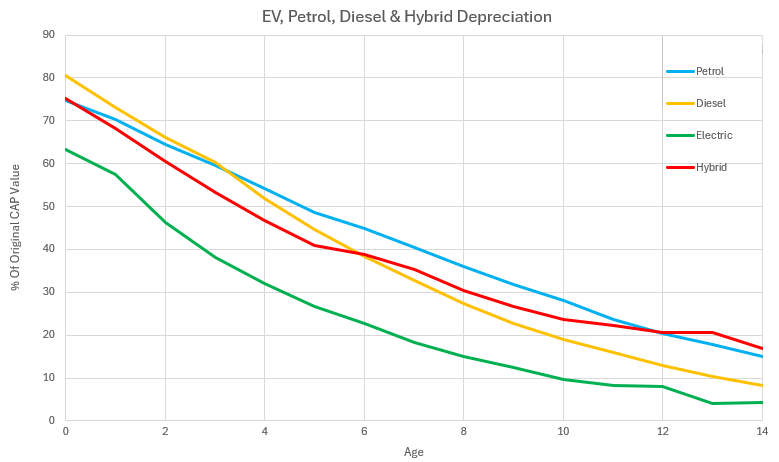
The following graph, created using webuyanycar and industry standard CAP data shows the average depreciation for EVs, compared with petrol, diesel, and hybrid cars.*
*Disclaimer: This data was collated in May 2026. Webuyanycar are not predicting future increases or decreases in your car’s market value. Changes in value can occur due to a variety of factors, including the vehicle’s age, mileage, condition, and the level of market demand. Learn more about what affects car value.
How much does an electric car depreciate every year?
- The average EV retains around 57% of its value after one year, falling to around 38% after three years.
- Diesel and petrol cars retain around 70-73% at one year, and around 60% at three years.
- Hybrids retain around 68% at one year, dropping to just over 50% at three years.
- EVs generally depreciate faster than other fuel types, and this gap only begins to narrow after year eight.
- Depreciation rates vary considerably by model; those with strong brand reputations, higher performance, and longer ranges tend to hold their value better than the average EV.
Comparing EV depreciation rates
The resale value of electric cars can be compared to that of petrol, diesel and hybrid cars. You can also compare the depreciation rates of various EV models.
How quickly do electric cars depreciate compared to petrol, diesel, and hybrid cars?
Autovista24's April 2026 UK market update showed that the average three-year-old car at 60,000km retained 47.4% of its original list price. By fuel type, BEVs had the lowest retained value at 34.6%, at three years.
| Fuel type | Retained value after 3 years/60,000km |
|---|---|
| Diesel | 58.3% |
| Hybrid electric vehicle (HEV) | 51.7% |
| Petrol | 48.7% |
| Plug-in hybrid electric vehicle (PHEV) | 44.5% |
| Battery electric vehicle (BEV) | 34.6% |
| Average across all fuel types | 47.4% |
Source: Autovista24
Note: Autovista24's benchmark of 60,000km over three years equates to approximately 12,400 miles per year, significantly higher than the UK average of around 7,100 miles annually (DfT, 2024). Petrol cars average closer to 6,200 miles per year, which may explain the higher depreciation shown for petrol in this dataset compared to other sources.
This suggests electric cars are still depreciating faster than petrol, diesel, and hybrid models on average, although depreciation varies significantly by model, age, battery condition, mileage, and market demand.
Which electric cars hold resale value best?
When it comes to EV resale values, the specific brand and model can make a big difference. Electric cars with strong badge appeal, longer real-world range and good ownership reassurance tend to hold their value better than older or less desirable models.
| EV model | Retained value after 36 months / 36,000 miles |
|---|---|
| Mercedes-Benz G580 EQ Tech AMG Line Premium+ | 65.1% |
| Mini Cooper Electric SE Classic 54kWh | 61.8% |
| Renault Scenic E-Tech Techno 87kWh Long Range | 58.8% |
| Porsche Macan Electric 100kWh Auto | 57.6% |
| Volvo EX90 Single Motor Plus 104kWh | 54.5% |
Source: What Car?
While the best-performing EVs can retain more than half of their value after three years, not all electric cars depreciate at the same rate. Older models with shorter ranges, slower charging speeds or weaker used-market demand can still lose value more quickly, so it’s worth checking your car’s current value before agreeing a part-exchange or sale.
Fastest depreciating electric cars in the UK
Some EVs lose their value considerably faster than others - and it's not always the cars you'd expect. Older models with shorter ranges, newer brands with limited UK track records, and cars where newer generations have arrived quickly can all see steeper drops at the three-year mark.
The reasons vary: low used car demand, ageing technology, faster-charging rivals entering the market, or simply a high new price that the second-hand market doesn't support. Here's how some of the current fastest depreciators stack up:
| EV model | Retained value at 36 months |
|---|---|
| GWM Ora 03 | 25.8% |
| Nissan Leaf | 26.5% |
| Jaguar I-Pace | 28.0% |
| Lexus UX 300e | 28.6% |
| DS 3 E-Tense | 28.9% |
Source: MotorEasy
What factors contribute to electric car depreciation?
Advancing technology
Technological obsolescence is a significant depreciation driver: when newer EVs offer meaningfully better range or features, older models with limited specs lose resale value fastest.
Supply and demand
When the available supply of used EVs outweighs consumer demand, this can cause prices to fall.
Conversely, if demand for a particular model is high, and it’s comparatively scarce in the showrooms, you can expect resale values to rise.
Age and mileage
EVs usually lose value as they get older and cover more miles. Depreciation is typically steepest in the first few years. Higher mileage can also reduce value, as buyers often associate it with greater wear and a higher risk of future repairs.
Desirability and brand reputation
EVs with strong demand, good reviews, desirable features and a reputation for reliability or quality often hold their value better. Less popular, outdated or harder-to-sell models may depreciate faster, especially if buyer confidence is affected by reliability concerns, recalls or poor battery-health perception.
Modifications
Modifications affect resale value. Changes that are niche, poorly fitted, irreversible, illegal or likely to increase insurance costs may put buyers off.
Condition and service history
Poor cosmetic or mechanical condition can reduce a car's value. A full service history helps reassure buyers that the vehicle has been maintained properly, while MOT history, recall checks, and repair records can also influence confidence in a used car.
Tips for reducing EV depreciation
All cars depreciate, and EVs are no exception. But good maintenance, sensible charging habits and overall condition can help protect resale value.
- Keep good records. Follow the manufacturer's servicing schedule and keep proof of maintenance, repairs and inspections.
- Protect the battery. Avoid regularly running it very low, leaving it at 100% for long periods, or relying too heavily on rapid charging. Visit our EV charging guide for more helpful tips.
- Reduce everyday wear. Drive smoothly, wash regularly in winter, and keep the bodywork, tyres and interior in good condition.
Modern EVs have battery management systems to help protect the battery, but good charging habits can still support long-term battery health.
Choosing a slow depreciating EV: Tips for buyers
- Buy used, ideally 1–5 years old: EVs follow a front-loaded depreciation curve, with the sharpest losses in year one, buying after that drop has already happened means slower losses for you.
- Stick to proven brands: Residual value rankings shift, but vehicles with strong consumer confidence and wide charging compatibility have tended to hold their value better than obscure or niche alternatives. A prestige badge alone is no guarantee of strong value retention; some premium EV models have depreciated faster than more mainstream rivals.
- Target at least 250 miles of real-world range: Battery health, warranty transferability, and charging speed are the primary drivers of EV resale prices.
- Request a SOH report: When buying used, always request a State of Health (SOH) report; a battery reading below 85% capacity can significantly reduce resale value.
- Be cautious with older EVs: Be cautious with older EVs, battery replacement can run to several thousand pounds, potentially exceeding the car's value. Always insist on an independent inspection and state-of-health (SOH) report before committing.
Frequently Asked Questions
Whether you’re planning to buy a new or used EV, depreciation matters, because it directly impacts the value of your investment. Depreciation is one of the most significant costs of car ownership.
Variables such as your choice of EV model, its age, range, technology, and shifts in consumer demand can all affect what your motor is worth over time.
If value for money sits high on your priority list, you should carefully research the potential depreciation of any EVs you are considering before you commit.
Yes, market data indicates that EVs often lose value faster than ICE equivalents within the first 36 months.
After this point, the rate of depreciation tends to slow, reaching roughly the same pace as a petrol or diesel car.
Unique factors such as rapidly evolving technology, high upfront costs, range anxiety, and battery degradation contribute to EVs depreciating at a faster rate than their ICE counterparts.
While hard to predict, a maturing EV market, stronger consumer confidence, and better charging infrastructure could help modern EVs retain more value, with depreciation rates eventually aligning more closely with petrol and diesel cars.
The 2030 ban on new petrol and diesel car sales may also increase EV demand as the deadline approaches, which could help to slow depreciation across many models.
To protect more of your investment and help secure the best resale price for your electric vehicle, focus on maintaining its overall condition and battery health.
- Keep a full service history by servicing your EV in line with the manufacturer's guidelines and retaining records of all maintenance work.
- Look after the battery by keeping the charge level between 20% and 80% where possible. Avoid frequent rapid charging, as this can contribute to premature battery degradation.
- Keep mileage low, as lower-than-average mileage can make your EV more appealing to buyers and help support its value.
- Preserve the car's condition by avoiding irreversible modifications and washing it regularly.
According to webuyanycar data, the average EV depreciates at a faster rate than any other powertrain.
On average, an EV retains roughly 40% of its value after three years, whereas petrol and diesel cars retain closer to 50%.
However, high demand in areas with emission zones can positively impact resale prices of electric cars. Additionally, as the 2030 ban on ICE cars approaches, increased demand for EVs may help narrow this value gap.
Some EV models hold their value significantly better than the market average. According to WhatCar, the following models are among the strongest for estimated value retention after 36 months:
- Mercedes-Benz G580 EQ Tech AMG Line Premium+: 65.1%
- Mini Cooper Electric SE Classic 54kWh: 61.8%
- Renault Scenic E-Tech Techno 87kWh Long Range: 58.8%
- Porsche Macan Electric 100kWh Auto: 57.6%
- Volvo EX90 Single Motor Plus 104kWh: 54.5%
Models like these tend to retain more of their value due to factors such as brand reputation, reliability, desirability, and long-range capability.